2022-03-21

What We Merit, part 2


Talent + Effort

Merit, or deservingness, is a product of two factors: talent, ability, natural gifts on the one hand and effort, hard work, training on the other. We'll look at the talent side, and then at the effort side.

First, let us ask: from where did the talent come? Some of it came from genes – that’s luck. Some of it came from childhood experiences. But growing up in the right sort of environment to bring out a given ability is not something the individual made happen. That’s also luck.

The other factor – effort, hard work, motivation, training -- isn’t always possible to separate from native talent. But whether you have the opportunities for training, have good coaches available, and training facilities, have encouraging people around you, and an environment that yields enough reward for hard work early on so that it develops as a habit – that’s all luck. There may also be a genetic component in predisposing some people to focused work and delayed gratification, and, if so, that would also be luck.

Getting to Third Base

There’s a question in this month’s issue of On the Journey, on the theme, Humility. It asks: “In what ways are you, too, guilty of 'being born on third base and thinking you hit a triple'?” The question presupposes a dichotomy between earning your way to something, or just being lucky. But if we look closer, we see it’s luck either way.

If you were born on third base, well, that’s luck.

And if you actually did hit a triple, let’s face the fact that that was luck, too. To be born in a time in which baseball exists, to have a natural talent for hitting a ball with a stick, to have good teachers and coaches and a training environment that was neither so frustrating as to be discouraging nor so easy as to be so boring you moved on to other pursuits -- and then to have the pitcher throw you just the pitch you were ready for, and for your line drive not to go right at a fielder – all luck.

Yet the rhetoric of merit, of deservingness, predominates.

Justice Distributive and Contributive

The more we’ve emphasized meritocracy, the greater our inequalities of income and wealth have grown. Or maybe it’s the other way around: as our inequality has shot up since 1980, we’ve responded by rationalizing it with an increasingly dominant rhetoric of merit. Either way, the rise of emphasis on merit and the rise of inequality correlate.

Distributive justice is needed for fairer, fuller access to the fruits of economic growth and a reduction in inequality. Beyond distributive justice, we need contributive justice: the opportunity to contribute meaningfully to others. It’s contributive justice that fosters the sense that we’re in this together.

Human beings require the social recognition and esteem that goes with producing what others need and value. An adequate wage is part of that. It’s hard to feel your society really values your work if they won’t pay you much for it. But the point isn’t just redistributing income and wealth. It’s that people should get a good income because they’re doing work that really matters to other people. The distributive justice and the contributive justice need to go hand in hand.

As Sandel writes,
“The fundamental human need is to be needed by those with whom we share a common life. The dignity of work consists in exercising our abilities to answer such needs. (The Tyranny of Merit 212)”

Robert F. Kennedy understood this. Campaigning in 1968, he said,
“Fellowship, community, shared patriotism – these essential values of our civilization do not come from just buying and consuming goods together.”
They come from
“dignified employment at decent pay, the kind of employment that lets a man say to his community, to his family, to his country, and most important, to himself, ‘I helped to build this country. I am a participant in its great public ventures.’” (RFK: Collected Speeches 385-86)
Politicians don't much talk that way anymore.

What We Merit

What do we merit? Suppose the answer were: nothing. Merit is a pretense. The supposed distinction between luck and deservingness collapses under scrutiny.

There are certain spheres of life where the pretense is necessary. When it’s time to ask the boss for a raise, you go in and make the case for how you deserve it. But later, when you're back home, in a moment of calm reflection where you can step back from your work life and can view it in your spiritual, holistic capacity, then you can appreciate that, really, there is no deserving. It’s all grace. You just happened to have some skills – including the skill called “motivation” – and you just happened to live in a world with market demand for your particular skills – and just happened to have the boss and the company that you do.

Now: Can you hold on to that spiritual truth even as you return again to the sphere of markets and work? It’s like the capacity to play a game -- parcheesi or gin rummy or chess -- while at the same time knowing that you’re just playing a game. Or like the capacity to watch an engrossing movie, while a part of you retains the consciousness that what you’re looking at is just lights projected on a screen. In the case of games and movies, it's pretty easy. In the case of merit, it takes a special spiritual maturity. As Max Weber observed,
“the fortunate person is seldom satisfied with the fact of being fortunate. Beyond this, he needs to know that he has a right to his good fortune. He wants to be convinced that he ‘deserves’ it, and above all, that he deserves it in comparison with others. He wishes to be allowed the belief that the less fortunate also merely experience their due. Good fortune thus wants to be 'legitimate' fortune.” ("The Social Psychology of the World Religions" [1915])
To be able to hold before you unwaveringly the insight that your good fortune really is just good fortune -- really is utterly undeserved -- to never forget that for a moment -- even when you’re in the middle of an intense round of the game called, “demanding what you deserve,” – that is a difficult spiritual challenge.

I regularly bring myself back to this awareness that it’s all grace, that none of it is deserved or earned, but that bit about “never forget for a moment” is beyond me. I do regularly bring myself back to remembering, but that’s because I do regularly forget.

This might be your first glimpse of seeing through the illusion of merit – the first time it came to your notice that the distinction between deserving and lucky is illusory. So I invite you to hold on to that. Don’t let it slip away. Rest in that new way of seeing, and imagine what it might be like to live that way – with awareness that merit is a fiction, a game you are sometimes called upon to play, but which you recognize isn’t real.

If you imagine holding that awareness in your mind, what difference would that make for your life? For one thing, if you’re sharply aware that it’s all luck, then you’ll be less caught by surprise when the luck changes. Market shifts can make your particular skills no longer in demand. A sudden accident or disease can make your body no longer able to play the violin, or hold a scalpel steady – or can make your mind less able to concentrate. In the vagaries of fortune, if you’ve thoroughly grasped that your success is not deserved, then you’ll be prepared to see that your failure isn’t either.

And something else. Not only do you not deserve your failure, but you’ll more clearly see that other people don’t deserve theirs.

Under the meritocratic ethic, my success is my own doing, so other people’s failure must be their fault. Meritocracy thus corrodes commonality. It traps me within the delusion that we aren’t in the same boat. It says I built my boat, and you built your boat, so there’s no particular reason I need to be concerned if yours is sinking.

But if I see my situation as wholly an undeserved grace, then I can imagine a new and harsher grace that might put me in someone else’s shoes. (Ram Dass, after the stroke that left him wheelchair-bound, called it 'fierce grace.') And if I can have that clarity, then my life turns in a different direction, turns toward a different task.

My task is not to out-compete others for the prizes of success and status. Nor is it to facilitate my children in out-competing others. My interest shifts from the prizes available only to the winners to restoring the dignity of all work.

There is a possible world in which everyone, whatever their talents and training, can meaningfully contribute their work to our shared public enterprise, and meaningfully contribute their voice to democratic deliberation that forms that enterprise. It will be no easy thing to get there from here. It will take, at best, several generations to reverse the effects of the last several generations.

Meanwhile, here in the microcosm of a congregation, we practice. Week in and week out, we embody a communal life without meritocracy, where we stand together on ground of equality, where everyone can meaningfully contribute to our shared enterprise, where we learn together an ever-deepening appreciation of grace and our inherent solidarity. Week in and week out, we are demonstrating to the world a better way.

Amen.


2022-03-20

What We Merit, part 1


Preface: The Mechanically Moral Universe

The mechanically moral universe thesis says the universe rewards virtue and punishes wickedness. If virtue goes in, you get reward out; wickedness in, punishment out – as if the universe were a great moral machine, a cosmic meritocracy. Wisdom from the Hebrew Bible has for thousands of years reminded readers that life is not all about getting what one deserves.

First, from the book of Ecclesiastes, chapter 9, verse 11:
“Again I saw that under the sun the race is not to the swift, nor the battle to the strong, nor bread to the wise, nor riches to the intelligent, nor favor to the skillful; but time and chance happen to them all.” (NRSV)
Second, the Book of Job. Here is Michael Sandel’s exposition.
“A just and righteous man, Job is subjected to unspeakable pain and suffering, including the death of his sons and daughters in a storm. Ever faithful to God, Job cannot fathom why such suffering has been visited upon him.... As Job mourns the loss of his family, his friends (if one can call them friends) insist that he must have committed some egregious sin, and they press Job to imagine what that sin might be. This is an early example of the tyranny of merit. Armed with the assumption that suffering signifies sin, Job’s friends cruelly compound his pain by claiming that, in virtue of some transgression or other, Job must be to blame for the death of his sons and daughters. Although he knows he is innocent, Job shares his companions’ theology of merit, and so cries out to God asking why he, a righteous man, is being made to suffer. When God finally speaks to Job, he rejects the cruel logic of blaming the victim. He does so by renouncing the meritocratic assumption that Job and his companions share. Not everything that happens is a reward or a punishment for human behavior, God proclaims from the whirlwind. Not all rain is for the sake of watering the crops of the righteous, nor is every drought for the sake of punishing the wicked....God confirms Job’s righteousness but chastises him for presuming to grasp the moral logic of God’s rule. This represents a radical departure from the theology of merit....In renouncing the idea that he presides over a cosmic meritocracy, God asserts his unbounded power and teaches Job a lesson in humility. Faith in God means accepting the grandeur and the mystery of creation, not expecting God to dispense rewards and punishments based on what each person merits or deserves.” (The Tyranny of Merit 36)
Grace and Solidarity

Grace and solidarity: these two seem to me to pretty well sum up what makes a good life. Grace: the freely given, unmerited gifts you did not earn and do not deserve. Like being alive. Like being more or less healthy – healthy enough and pain-free enough to be able to be reading this right now. Like air, and the feel of breath in your lungs. Like sunlight, rain, autumn leaves, or a warm breeze on this first day of Spring. You didn’t earn those things. You’ve done nothing to deserve them. They are free gifts – grace.

You might choose to not notice them. But a life of richness and depth is one that is constantly seeing grace everywhere – the beauty all around us.

And: solidarity. We’re not in it just for ourselves. We’re in this together. We are here for each other – what else?

Grace and solidarity. As those are the crux of a good life, it behooves us to attend to whatever undermines the place in our lives of grace and solidarity.

The Corrosive Meritocratic Ethic

An emphasis on merit – on who deserves what – is the killer of both grace and solidarity. The meritocratic ethic says that life is all about two other things: ability and hard work, also known as talent and effort, or capability and motivation. From these two come your merit, your deservingness for success and status. The meritocratic ethic casts life as a zero-sum game – a competition, and, as per the nature of competition, winning means causing someone else’s loss. Michael Sandel, in The Tyranny of Merit, says of the meritocratic ethic:
“Among the winners, it generates hubris; among the losers, humiliation and resentment. These moral sentiments are at the heart of the populist uprising against elites. More than a protest against immigrants and outsourcing, the populist complaint is about the tyranny of merit. And the complaint is justified. The relentless emphasis on creating a fair meritocracy, in which social positions reflect effort and talent, has a corrosive effect on the way we interpret our success (or the lack of it).” (25)
The meritocratic ethic produces a
“smug conviction of those who land on top that they deserve their fate, and that those on the bottom deserve theirs, too.” (25)
For those on the bottom, the meritocratic ethic means either frustration or humiliation and despair. Either they believe that the system fails to recognize their merit and denies them opportunities to use it – or, perhaps worse, they accept that meritocratic sorting has been more-or-less fair, and they just aren’t good enough to have earned any better than they got.

The Rise of Meritocracy

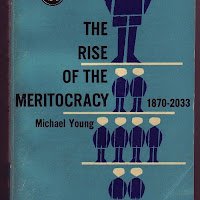
The grip of the meritocratic ethic has been growing through the post-World War II era. A 1958 book, The Rise of the Meritocracy, by British sociologist Michael Young, described meritocracy as a dystopia.

By 1958, the British class system had been breaking down for some time. The old aristocracy had been giving way to a system of educational and professional advancement based on merit. In many ways, this was a good thing. Gifted children of the working class could develop their talents and escape from a life of manual labor. But the old system at least had the weird advantage that everybody knew it was unfair. Neither the Lords nor the working class believed they deserved their status – which tempered the arrogance of the upper-class and precluded despair for the laborers. The working class knew their situation wasn’t their own fault.

Michael Young, writing from an imagined position in the year 2033 (75 years in his future), said:
“Now that people are classified by ability, the gap between the classes has inevitably become wider. The upper classes are no longer weakened by self-doubt and self-criticism. Today the eminent know that success is just reward for their own capacity, for their own efforts, and for their own undeniable achievement. They deserve to belong to a superior class. They know, too, that not only are they of higher caliber to start with, but that a first-class education has been built upon their native gifts.” (The Rise of the Meritocracy 106)
Meanwhile the losers in the meritocracy are resentful at the arrogance of the winners while also humiliated with the knowledge that they have no one to blame but themselves.
“Today, all persons, however humble, know they have had every chance.... Are they not bound to recognize that they have an inferior status – not as in the past because they were denied opportunity; but because they ARE inferior? For the first time in human history, the inferior man has no ready buttress for his self-regard.” (108-9)
Michael Young’s tale from 1958 predicted that in 2034 the less-educated classes would rise up in a populist revolt against the meritocratic elites. We can now say that the revolt that Young predicted came 18 years ahead of schedule, in 2016, when Britain voted for Brexit and America voted for Trump.

Centering the Field of Competition

While Democratic candidates, and many Republicans were repeatedly intoning that everybody ought to be able to go as far as their talent and hard work could take them, Trump never said that. His fans knew that the meritocratic game cast them as the losers, that their work no longer had much dignity, or even afforded much of a living any longer. Their feelings of both humiliation and resentment proved potent.

If the game being played on the field is one that inherently has winners and losers, then leveling the playing field does nothing to revitalize civic life, does nothing to foster a sense that we’re all in this together, does nothing to shore up solidarity. Is that the world we want? Hubris, arrogance, for the winners and despair and humiliation for the losers?

There will always be a place for competition – for working hard to win, for reaping rewards when you do, and for coping with the disappointment when you come up short. But even competition can be approached in a cooperative spirit – as an exercise in working together to spur each other to greater excellence. This way, I’m not trying to win for winning’s sake. I’m trying to hold the bar as high as I can to help you practice rising to it, while understanding that you’re doing the same for me. The point isn’t the winning or losing – the point is working together to develop our excellence. The win or loss is just feedback we get along the path of that pursuit.

Sandel writes that,
“a perfect meritocracy banishes all sense of gift or grace. It diminishes our capacity to see ourselves as sharing a common fate. It leaves little room for the solidarity that can arise when we reflect on the contingency of our talents and fortunes. This is what makes merit a kind of tyranny, or unjust rule.” (The Tyranny of Merit 25)
There’s a lot of talk of leveling the playing field – and for those aspects of life where there should be competition, the playing field does need to be level. Where we decide to have competitions for some prize or other – a college admission, a job, an elective office – it is right and proper that we ensure that the competition be fair.

But when we make the levelness of playing field the major concern, we forget that public life isn’t all about the competition. It’s about recognizing that we’re in this together. It’s about standing as equals with each other as neighbors, engaged in the work of citizenship (whether we are legal citizens or not).

It’s not all about standing as competitors in a zero-sum game. We may, from time to time, want or need to meet on a competitive playing field, but meritocracy puts that competition at the center of public life, instead of putting our shared civic enterprises at the center.

Meritocracy also puts that competition at the center of our individual sense of who we are. Meritocracy defines us – to each other and to ourselves -- by what we deserve, what we earn. It teaches us relative disregard for all the range of life that isn’t, or shouldn’t be, marketable.

The Perfect Meritocracy: Sports

"Level playing field" is a sports metaphor, and sports is often held up as the perfect meritocracy. There’s ability, and there’s the hard work of training to maximize that ability – and that’s it. In sports, it’s apparently easy to believe that everybody really can go as far as their ability and hard work will take them.

But even in this most perfect of meritocracies, let’s notice that the race isn’t always to the swift nor the battle to the strong. The ball can take a funny bounce. Sometimes a bad hop can determine the outcome of a championship game. It’s luck.

Suppose there is no funny bounce or gust of wind. Suppose, say, a basketball game comes down to one free throw, and an 80% shooter is on the line. Her talent and her training got her to the point where she’s an 80% shooter. But whether this one shot will be one of the 80% she makes or one of the 20% she misses – that’s luck.

There’s always luck. And let’s dig deeper. Where did the ability and the training come from?

Next: digging deeper


2022-03-19

UU Minute #79

Unitarians and Slavery: William Ellery Channing


In 1833, Lydia Maria Child’s book, An Appeal in Favor of that Class of Americans Called Africans, came out, and that same year, William Ellery Channing read it. He was so moved that he walked from Boston to Roxbury to thank Child for the book.

It must be admitted that Channing was a bit slow to address the slavery issue.
“When Channing grew up in Newport, [Rhode Island], the slave trade was still active there. His own nanny was, or had been, enslaved.
After college, he worked as a tutor on a plantation in Tidewater Virginia. In the winter of 1831, he went to the Virgin Islands for a rest cure for his chronic tuberculosis. There he came to see white racism as another chronic illness, not one easily abolished simply by will or fiat.” (Buehrens)
And yet years kept rolling by without Channing’s eloquence speaking up strongly against slavery.

The fact that Boston’s most powerful industrialists were pro-slavery, and that Channing’s Federal Street Church membership included many them, may have inhibited him.

He promised he would speak out – yet another year went by. In 1834, the 54-year-old Channing received a visit from his colleague in Unitarian ministry, Rev. Samuel Joseph May who was with the Anti-Slavery Society. Why had Channing remained silent on slavery, May pressed, and reminded him of the promise he’d made.

Channing replied, “Brother May, I must acknowledge the justice of your reproof. I have been silent too long.”

Channing spent the next summer, 1835, writing a small book called Slavery. On the one hand, he condemned slavery in uncompromising terms. On the other hand, he rejected the label “abolitionist” as tainted with harsh rhetoric and unrealistic, immediate solutions.


NEXT: Rev. Charles Follen

2022-03-13

Humility, part 2

The fourth difficulty some Unitarians have with humility is that we can be proud of the way we are, and we don’t want to let that go. Many of us have a lot of education. I do – because I enjoyed wrestling with recondite texts and then meeting with others in classrooms and seminars to talk about them. That was my idea of fun, and I had enough generational privilege to be able to do that.

Many of us tend to be proud of our schooling and erudition. Those years in school were good for something, we are convinced. They improved us. They made us better that we were. We might not like to admit out loud to the logical train that follows from that, but our egos put two and two together: if we now are better than our less educated former selves, and if our less educated former selves were the equals of their peers, then it logically follows that we now are better than those peers who didn’t get the improvement. So, yeah, there’s some hubris there.

It was years after my last degree before I gradually started to think of those years less in terms of how wonderful it was to get educated and more in the terms I just used: going to school was just something I enjoyed doing, and had the privilege to be able to. Yes, it changed and shaped me, but anything else I’d have done during those years would also have changed and shaped me. Experiences can make us wiser – if we have the temperament to let them – but experiences of reading books or of sitting in classrooms are no more likely to do so than experiences of lots of other kinds.

Still, the hubris of thinking otherwise is a common affliction among Unitarian Universalists, and I confess my own antibodies for that affliction do not always suffice to keep me symptom-free. That’s the fourth difficulty we might have with humility. Setting aside our hubris is no easy thing, but it’s crucial if we are to be more welcoming of diversity – including diverse paths to maturity that might not have included college.

A fifth difficulty we may have with humility might be that we’ve seen it used by the powerful as a way to keep the less empowered down. We’ve seen calls for humility that seemed more interested in other people being humble than the person doing the calling.

What the poor and oppressed need are allies that help empower them, that encourage them to pursue their power, and what they have too often gotten are songs of praise for how great it is to be humble. We’ve seen the seen the voices of the self-interested powerful rebuff calls for equality as overly prideful. “They should be more humble – not so arrogant as to demand any rights. People need to keep in their place.”

What’s going on there, of course, is that certain people have gotten used to a certain order of things. That order works for them. They are comfortable with it. It feels to them right and proper, so they’re nervous about upsetting that order. When they meet a call for change – a call from people who have not been treated fairly to be treated more fairly – that feels like arrogance, like people arrogating to themselves improper powers and authority.

There’s a close logical connection between arrogating and not keeping in one’s place – so the parties interested in keeping people in their place naturally find it arrogant when those people express a preference for not keeping to the place to which they have been relegated.

Having diagnosed the problem as one of arrogance, the privileged naturally respond by calling for humility. But the fact that this happens is not humility’s fault. The moral of this story is not that humility itself is a suspicious, but that humility has to begin at home, and that we should especially cultivate humility against passing judgment on other people’s arrogance.

One of the other slogans from the recovery community that you may have heard is that when you point the finger at someone, there are three fingers pointing back at you. So when we feel an impulse to regard someone else as arrogant, it’s time to examine what arrogance in ourselves might be taking such offense at someone else’s behavior.

The point here applies to the “troublemakers” in the political realm, and also to those in your personal life – family members or coworkers who make trouble for you. As Pema Chodron reminds us, “It’s the troublemakers in your life who cause you to see that you’ve shut down, that you’ve armored yourself, that you've hidden your head in the sand.”

To recap: I’ve mentioned five difficulties we might have with humility, and offered a response to each:
  1. We might associate it with putting ourselves down. That’s not what we’re talking about.
  2. We might suppose that humility is superfluous, unnecessary. But I argue that it’s an important enabling virtue to give some attention to how our ego defenses can block development of general virtue.
  3. We might find it perplexing or self-contradictory to self-assess humility. But we don’t need to assess it – just stay on the path, paying attention to it.
  4. We have achievements that we are proud of – and for many Unitarians, it’s our intellects and our education. Yes, that is a difficulty, and it’s one that we can – and at our best, do – face head-on and try to get over.
  5. Humility has been invoked in the interests of keeping other people in their place. But the misuse of a concept doesn’t mean we should throw out the concept.
Let’s turn now to a kind of humility that Unitarian Universalists actually have taken to heart and embody. Our epistemic humility, I think, is one of the best things about the UU way. "Epistemic" means having to do with knowledge, thus "epistemic humility" is modesty about what we claim to know. Epistemic humility is pretty firmly etched into Unitarian Universalist DNA. This doesn't mean that there aren't some UUs who act like know-it-alls. I just mean that our institutional culture encourages modesty about what we can claim to know.

Many of us identify as agnostic, and even if that’s not our identity, we’re pretty comfortable not knowing. We recognize the limitations of our own perspectives. Some of us left the church of our childhood because it seemed to claim as certainty statements of which we just couldn’t be certain and weren't comfortable pretending to be. We found our way to a Unitarian Universalist congregation and noticed that it doesn’t deal in dogmatic certainties.

Instead, here, we heard things like, “We see things not as they are, but as we are.”
And: “Revelation is not sealed – we don’t know final truth. Our understanding is ever evolving.”
And: “All of us are smarter than any of us.”

Perhaps we became part of a Journey Group and noticed the importance that Unitarian Universalists place on hearing each other’s voices, rather than attending just to some voice of authority. The ingrained epistemic humility of the Unitarian Universalist way was refreshing, and felt right, and so: we stayed -- eventually signed the membership book and became Unitarian Universalists ourselves.

From our not-perfect-but-pretty-solid grounding in epistemic humility, we can build the attitudes a general wholesome humility. Your particular combination of skills and talents; knowledge, memories, and insights; quirks and preferences; habits and hopes; the sound of your voice; that way you move your hand; the things that make you laugh; the things that make you cry; your face – these have never existed before all together in one person and never will again. And here you are to bring all of who you are to this world we share. Not in order to leave your mark. The world is marked up enough. Yet here you are now in your wonderful and precious uniqueness – here to be forgotten later but here now to add your love to the onward flow of all things; to transfer forward the nutrients that made you, and filter out some of the toxins you’ve also absorbed. You’re here to add your creative new ideas, your reiteration of favorite old ideas, your soaring dreams, and your careworn anxieties to the ongoing regenerating and evolving of life.

May it be so.

2022-03-12

UU Minute #78

Unitarians and Slavery: Lydia Maria Francis Child


Lydia Maria Francis, born 1802, and her brother Convers Francis were raised by a strict Calvinist father, yet both of them became Unitarian. In 1819, Convers became the Unitarian minister serving our congregation in Watertown, Massachusetts. The next year, Lydia, age 18, joined the Unitarians.

Lydia was a writer and activist. Her first novel came out when she was 22. At age 26, she married David Lee Child.

In 1833, after having written about a dozen books – novels, histories, household management, poems – she wrote An Appeal in Favor of that Class of Americans Called Africans. It was the first anti-slavery work printed in America in book form. It argued – as did William Lloyd Garrison -- for immediate emancipation of the enslaved people without compensation to their legal owners. Analyzing slavery from a variety of angles—historical, political, economic, legal, and moral – she showed that Africans were intellectually equal to Europeans and that emancipation was practicable.

Her book brought social ostracism, but she only expanded her anti-slavery efforts. She became an organizer in anti-slavery societies. In 1839, Child was elected to the executive committee of the American Anti-Slavery Society and became editor of the society's National Anti-Slavery Standard in 1840. Her editorship, including the columns she wrote, made the National Anti-Slavery Standard one of the most popular abolitionist newspapers in the US.

She was also writing a number of short stories, exploring, through fiction, the complex issues of slavery. Later, living in Wayland, Massachusetts, the Childs provided shelter for runaways from enslavement trying to escape the Fugitive Slave Law.

Unfortunately, not all Unitarians of the time were as abolitionist as Lydia Maria Francis Child.


NEXT: Unitarians and Slavery: William Ellery Channing

2022-03-06

Humility, part 1

The March theme here at Community UU at White Plains, NY, is humility. We Unitarian Universalists aren’t great with the humility thing. We tend to be a bit suspicious of it, for a number of reasons.

What I’ll do, today, is go through a list of those reasons. One by one, we’ll consider five difficulties with the idea of humility. And then we’ll look at a kind of humility that I think Unitarians actually have taken to heart and embody – a humility, I’d say, that is at the essence of Unitarian Universalism.

Humility as Putting Oneself Down

The first difficulty is the idea that humility means putting yourself down. This is the simplest one to dispense with: that’s not what we’re talking about. Humility is not exemplified by someone who’s always putting themselves down. They might be doing it because they really have low self-esteem. Or maybe they’re very insecure and need you to contradict their bad assessment and tell them they’re fine. Either way, that’s not humility.

Putting yourself down is not humility because it’s still focused on you. Prideful, boasting arrogance is one way to be focused on yourself. Abasing yourself is another way to be focused on yourself. These apparent opposites – having a very high opinion of yourself and having a very low opinion of yourself -- share a preoccupation with the self. They both put the self at the center. Humility is about decentering of the self – focusing on others, shifting focus away from oneself and toward the situation at hand, toward the present needs, toward the task, toward serving. “Humility,” as C.S. Lewis nicely put it, “isn’t thinking less of yourself, but thinking of yourself less.”

A self-centered life is barren and sterile. A saying that’s been circulating in various versions for over a century is that a person all wrapped up zirself makes a small package. Humility is not denying that we have worth and value. It’s simply a focus on serving others rather than on what others think of us.

Humility as Superfluous; Not a Virtue

Even when we grasp clearly that humility is not about thinking you don’t matter, but about being unconcerned with mattering and just responding to the needs of the situation, Unitarians may remain unconvinced that humility has value. By all means, some of us might say, let us value service and compassion, being respectful, considerate, and kind. But if we value and practice those things, then it is enough to value and practice them. We don’t need an additional value called “humility.”

So that’s the second difficulty: the idea that humility is superfluous – an unhelpful redundancy. If the argument for humility is that it orients us toward service and compassion, then why not focus directly on the service and compassion and skip the humility?

Indeed, there are some strands within the Western philosophical tradition that might seem to suggest we not regard humility as a virtue. Aristotle, for instance, wrote at length about the virtues and becoming a virtuous person, and he does not seem to have regarded humility as a virtue. Aristotle’s idea of the ideal person was someone he called “great-souled." Such a person deserves honors and knows ze deserves honors. For Aristotle, the nine important virtues are:
  • wisdom (theoretical);
  • prudence (practical wisdom, skillful decision-making about action);
  • justice (treating people fairly);
  • fortitude (persevering in the right thing under difficult circumstances or threat of harm);
  • courage (mediating between recklessness and cowardice);
  • liberality (in spending money, mediating between prodigality and parsimony);
  • magnificence (spending large sums in order to bring grand things into the world);
  • magnanimity (eschewing pettiness, facing dangers, pursuing noble purposes);
  • temperance (moderation in the indulgence of pleasures, esp. food, drink, sex).
A person who has those virtues is justified in claiming to have them – no need to be humble about it.

18th-century Scottish philosopher David Hume said humility was a “monkish” pseudo-virtue, along with celibacy, fasting, silence, and solitude. These pseudo-virtues, Hume said, “stupefy the understanding and harden the heart, obscure the fancy and sour the temper.” If you’re great, isn’t it OK to know that you’re great? And not pretend otherwise?

But, again: humility isn’t thinking less of yourself, but thinking of yourself less. The Aristotelian virtues require an orientation toward needs other than your own – so humility would have a role in enabling those other virtues. And Hume did recognize that “impudence and arrogance” were problematic -- and that “a due attention and regard for others” was an important trait.

The thing is: focusing directly on service and compassion doesn’t always succeed. We have egos, and mechanisms to protect and defend those egos – and those are fine when they help us stand up for what is rightfully ours, or help keep us safe. But those ego protections can get in the way, manifest as arrogance, and steer us away from compassionate service, or from any of Aristotle’s virtues. Humility, then, is an “enabling virtue.” That is, paying attention to the idea of humility helps tame the impulse to arrogance so that we can be better oriented toward service, respect, kindness, compassion, and consideration – or toward wisdom, prudence, justice, fortitude, courage, liberality, magnificence, magnanimity, and temperance.

Humility -- along with patience, self-control, and courage – helps us overcome the impulses and inclinations that run contrary to virtue. As such, humility has a crucial role in the development of virtue.

This raises, however, a third difficulty – and that is that humility is so tricky to self-assess.

The Paradox of Assessing One's Humility

If we’re thinking in terms of the development of virtues, then don’t we need to have some sense of how much development has happened at any given point along our path? Accurately assessing how patient you are, say, or how courageous, isn’t exactly easy, but the attempt at least makes sense. There’s no self-contradiction. But humility is different. If you think you’re good at humility, doesn’t that prove that you aren’t? Saying “I’m humble” sounds like a self-undermining joke in a way that saying “I’m compassionate” or “I treat people fairly” does not. When it comes to humility, it seems that realizing you have it somehow spoils it. If you have it, you won’t know it -- and if you think you have it, you probably don’t really!

On this point, I suggest we take our cue from the recovery community. One of their slogans is, “always recovering, never recovered.” Self-assessment of how much progress you’ve made is not, after all, necessary. Just stay on the path. You don’t need to know how far you’ve come. You don’t need to know how much farther you have to go. Just stay on the path.

Whether the pertinent addiction is addiction to ego and to our ego-protection mechanisms, or addiction to alcohol, there is no point of “being recovered” – never a time when you can say “mission accomplished.” There is only staying on the path of recovering. And if you notice that you fell off the wagon, do your best to climb back on.

In Part 2, we'll look at the fourth difficulty with humility common among Unitarians (we're so darn proud of our intellects and education), and the fifth difficulty (we've seen humility invoked in the interests of keeping other people in their place). Then we'll look at how one kind of humility -- epistemic humility -- is, in fact, a core part of the Unitarian Universalist outlook.

2022-03-05

UU Minute #77

Likeness to God


William Ellery Channing’s 1819 manifesto, “Unitarian Christianity” embraced the name “Unitarian” for the liberal congregationalists, and laid out principles that remain key to who we are. Channing was the intellectual, moral, and spiritual leader of Unitarianism for 23 more years, until his death at age 62. Ralph Waldo Emerson himself referred to Channing as “our bishop.”

Channing rejected Trinitarianism – the point for which we Unitarians get our name. He also, like Unitarian forebears Fausto Sozzini and Joseph Priestly, rejected substitutionary atonement.

In an 1828 sermon, “Likeness to God,” Channing essentially addressed the question: “Who made whom in whose image?” Channing’s answer was one many of us today would still affirm. He said:
“The divine attributes are first developed in ourselves, and thence transferred to our Creator. The idea of God, sublime and awful as it is, is the idea of our own spiritual nature, purified and enlarged to infinity. In ourselves are the elements of the Divinity.”
Channing went on to say that humans had transcendent moral reason as part of our “higher or spiritual nature that has its foundation in the original and essential capacities of the mind.”

Inscribed on the back of the William Ellery Channing statue that stands in Boston’s Public Garden is a further passage from this same sermon:
“I do and I must reverence human nature. I bless it for its kind affections. I honor it for its achievements in science and art, and still more for its examples of heroic and saintly virtue. These are marks of a divine origin and the pledges of a celestial inheritance, and I thank God that my own lot is bound up with that of the human race.”


NEXT: Unitarians and Slavery: Lydia Maria Frances Child