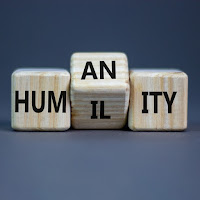
Showing posts with label Humility. Show all posts

2022-03-13

Humility, part 2

The fourth difficulty some Unitarians have with humility is that we can be proud of the way we are, and we don’t want to let that go. Many of us have a lot of education. I do – because I enjoyed wrestling with recondite texts and then meeting with others in classrooms and seminars to talk about them. That was my idea of fun, and I had enough generational privilege to be able to do that.

Many of us tend to be proud of our schooling and erudition. Those years in school were good for something, we are convinced. They improved us. They made us better that we were. We might not like to admit out loud to the logical train that follows from that, but our egos put two and two together: if we now are better than our less educated former selves, and if our less educated former selves were the equals of their peers, then it logically follows that we now are better than those peers who didn’t get the improvement. So, yeah, there’s some hubris there.

It was years after my last degree before I gradually started to think of those years less in terms of how wonderful it was to get educated and more in the terms I just used: going to school was just something I enjoyed doing, and had the privilege to be able to. Yes, it changed and shaped me, but anything else I’d have done during those years would also have changed and shaped me. Experiences can make us wiser – if we have the temperament to let them – but experiences of reading books or of sitting in classrooms are no more likely to do so than experiences of lots of other kinds.

Still, the hubris of thinking otherwise is a common affliction among Unitarian Universalists, and I confess my own antibodies for that affliction do not always suffice to keep me symptom-free. That’s the fourth difficulty we might have with humility. Setting aside our hubris is no easy thing, but it’s crucial if we are to be more welcoming of diversity – including diverse paths to maturity that might not have included college.

A fifth difficulty we may have with humility might be that we’ve seen it used by the powerful as a way to keep the less empowered down. We’ve seen calls for humility that seemed more interested in other people being humble than the person doing the calling.

What the poor and oppressed need are allies that help empower them, that encourage them to pursue their power, and what they have too often gotten are songs of praise for how great it is to be humble. We’ve seen the seen the voices of the self-interested powerful rebuff calls for equality as overly prideful. “They should be more humble – not so arrogant as to demand any rights. People need to keep in their place.”

What’s going on there, of course, is that certain people have gotten used to a certain order of things. That order works for them. They are comfortable with it. It feels to them right and proper, so they’re nervous about upsetting that order. When they meet a call for change – a call from people who have not been treated fairly to be treated more fairly – that feels like arrogance, like people arrogating to themselves improper powers and authority.

There’s a close logical connection between arrogating and not keeping in one’s place – so the parties interested in keeping people in their place naturally find it arrogant when those people express a preference for not keeping to the place to which they have been relegated.

Having diagnosed the problem as one of arrogance, the privileged naturally respond by calling for humility. But the fact that this happens is not humility’s fault. The moral of this story is not that humility itself is a suspicious, but that humility has to begin at home, and that we should especially cultivate humility against passing judgment on other people’s arrogance.

One of the other slogans from the recovery community that you may have heard is that when you point the finger at someone, there are three fingers pointing back at you. So when we feel an impulse to regard someone else as arrogant, it’s time to examine what arrogance in ourselves might be taking such offense at someone else’s behavior.

The point here applies to the “troublemakers” in the political realm, and also to those in your personal life – family members or coworkers who make trouble for you. As Pema Chodron reminds us, “It’s the troublemakers in your life who cause you to see that you’ve shut down, that you’ve armored yourself, that you've hidden your head in the sand.”

To recap: I’ve mentioned five difficulties we might have with humility, and offered a response to each:
  1. We might associate it with putting ourselves down. That’s not what we’re talking about.
  2. We might suppose that humility is superfluous, unnecessary. But I argue that it’s an important enabling virtue to give some attention to how our ego defenses can block development of general virtue.
  3. We might find it perplexing or self-contradictory to self-assess humility. But we don’t need to assess it – just stay on the path, paying attention to it.
  4. We have achievements that we are proud of – and for many Unitarians, it’s our intellects and our education. Yes, that is a difficulty, and it’s one that we can – and at our best, do – face head-on and try to get over.
  5. Humility has been invoked in the interests of keeping other people in their place. But the misuse of a concept doesn’t mean we should throw out the concept.
Let’s turn now to a kind of humility that Unitarian Universalists actually have taken to heart and embody. Our epistemic humility, I think, is one of the best things about the UU way. "Epistemic" means having to do with knowledge, thus "epistemic humility" is modesty about what we claim to know. Epistemic humility is pretty firmly etched into Unitarian Universalist DNA. This doesn't mean that there aren't some UUs who act like know-it-alls. I just mean that our institutional culture encourages modesty about what we can claim to know.

Many of us identify as agnostic, and even if that’s not our identity, we’re pretty comfortable not knowing. We recognize the limitations of our own perspectives. Some of us left the church of our childhood because it seemed to claim as certainty statements of which we just couldn’t be certain and weren't comfortable pretending to be. We found our way to a Unitarian Universalist congregation and noticed that it doesn’t deal in dogmatic certainties.

Instead, here, we heard things like, “We see things not as they are, but as we are.”
And: “Revelation is not sealed – we don’t know final truth. Our understanding is ever evolving.”
And: “All of us are smarter than any of us.”

Perhaps we became part of a Journey Group and noticed the importance that Unitarian Universalists place on hearing each other’s voices, rather than attending just to some voice of authority. The ingrained epistemic humility of the Unitarian Universalist way was refreshing, and felt right, and so: we stayed -- eventually signed the membership book and became Unitarian Universalists ourselves.

From our not-perfect-but-pretty-solid grounding in epistemic humility, we can build the attitudes a general wholesome humility. Your particular combination of skills and talents; knowledge, memories, and insights; quirks and preferences; habits and hopes; the sound of your voice; that way you move your hand; the things that make you laugh; the things that make you cry; your face – these have never existed before all together in one person and never will again. And here you are to bring all of who you are to this world we share. Not in order to leave your mark. The world is marked up enough. Yet here you are now in your wonderful and precious uniqueness – here to be forgotten later but here now to add your love to the onward flow of all things; to transfer forward the nutrients that made you, and filter out some of the toxins you’ve also absorbed. You’re here to add your creative new ideas, your reiteration of favorite old ideas, your soaring dreams, and your careworn anxieties to the ongoing regenerating and evolving of life.

May it be so.

2022-03-06

Humility, part 1

The March theme here at Community UU at White Plains, NY, is humility. We Unitarian Universalists aren’t great with the humility thing. We tend to be a bit suspicious of it, for a number of reasons.

What I’ll do, today, is go through a list of those reasons. One by one, we’ll consider five difficulties with the idea of humility. And then we’ll look at a kind of humility that I think Unitarians actually have taken to heart and embody – a humility, I’d say, that is at the essence of Unitarian Universalism.

Humility as Putting Oneself Down

The first difficulty is the idea that humility means putting yourself down. This is the simplest one to dispense with: that’s not what we’re talking about. Humility is not exemplified by someone who’s always putting themselves down. They might be doing it because they really have low self-esteem. Or maybe they’re very insecure and need you to contradict their bad assessment and tell them they’re fine. Either way, that’s not humility.

Putting yourself down is not humility because it’s still focused on you. Prideful, boasting arrogance is one way to be focused on yourself. Abasing yourself is another way to be focused on yourself. These apparent opposites – having a very high opinion of yourself and having a very low opinion of yourself -- share a preoccupation with the self. They both put the self at the center. Humility is about decentering of the self – focusing on others, shifting focus away from oneself and toward the situation at hand, toward the present needs, toward the task, toward serving. “Humility,” as C.S. Lewis nicely put it, “isn’t thinking less of yourself, but thinking of yourself less.”

A self-centered life is barren and sterile. A saying that’s been circulating in various versions for over a century is that a person all wrapped up zirself makes a small package. Humility is not denying that we have worth and value. It’s simply a focus on serving others rather than on what others think of us.

Humility as Superfluous; Not a Virtue

Even when we grasp clearly that humility is not about thinking you don’t matter, but about being unconcerned with mattering and just responding to the needs of the situation, Unitarians may remain unconvinced that humility has value. By all means, some of us might say, let us value service and compassion, being respectful, considerate, and kind. But if we value and practice those things, then it is enough to value and practice them. We don’t need an additional value called “humility.”

So that’s the second difficulty: the idea that humility is superfluous – an unhelpful redundancy. If the argument for humility is that it orients us toward service and compassion, then why not focus directly on the service and compassion and skip the humility?

Indeed, there are some strands within the Western philosophical tradition that might seem to suggest we not regard humility as a virtue. Aristotle, for instance, wrote at length about the virtues and becoming a virtuous person, and he does not seem to have regarded humility as a virtue. Aristotle’s idea of the ideal person was someone he called “great-souled." Such a person deserves honors and knows ze deserves honors. For Aristotle, the nine important virtues are:
  • wisdom (theoretical);
  • prudence (practical wisdom, skillful decision-making about action);
  • justice (treating people fairly);
  • fortitude (persevering in the right thing under difficult circumstances or threat of harm);
  • courage (mediating between recklessness and cowardice);
  • liberality (in spending money, mediating between prodigality and parsimony);
  • magnificence (spending large sums in order to bring grand things into the world);
  • magnanimity (eschewing pettiness, facing dangers, pursuing noble purposes);
  • temperance (moderation in the indulgence of pleasures, esp. food, drink, sex).
A person who has those virtues is justified in claiming to have them – no need to be humble about it.

18th-century Scottish philosopher David Hume said humility was a “monkish” pseudo-virtue, along with celibacy, fasting, silence, and solitude. These pseudo-virtues, Hume said, “stupefy the understanding and harden the heart, obscure the fancy and sour the temper.” If you’re great, isn’t it OK to know that you’re great? And not pretend otherwise?

But, again: humility isn’t thinking less of yourself, but thinking of yourself less. The Aristotelian virtues require an orientation toward needs other than your own – so humility would have a role in enabling those other virtues. And Hume did recognize that “impudence and arrogance” were problematic -- and that “a due attention and regard for others” was an important trait.

The thing is: focusing directly on service and compassion doesn’t always succeed. We have egos, and mechanisms to protect and defend those egos – and those are fine when they help us stand up for what is rightfully ours, or help keep us safe. But those ego protections can get in the way, manifest as arrogance, and steer us away from compassionate service, or from any of Aristotle’s virtues. Humility, then, is an “enabling virtue.” That is, paying attention to the idea of humility helps tame the impulse to arrogance so that we can be better oriented toward service, respect, kindness, compassion, and consideration – or toward wisdom, prudence, justice, fortitude, courage, liberality, magnificence, magnanimity, and temperance.

Humility -- along with patience, self-control, and courage – helps us overcome the impulses and inclinations that run contrary to virtue. As such, humility has a crucial role in the development of virtue.

This raises, however, a third difficulty – and that is that humility is so tricky to self-assess.

The Paradox of Assessing One's Humility

If we’re thinking in terms of the development of virtues, then don’t we need to have some sense of how much development has happened at any given point along our path? Accurately assessing how patient you are, say, or how courageous, isn’t exactly easy, but the attempt at least makes sense. There’s no self-contradiction. But humility is different. If you think you’re good at humility, doesn’t that prove that you aren’t? Saying “I’m humble” sounds like a self-undermining joke in a way that saying “I’m compassionate” or “I treat people fairly” does not. When it comes to humility, it seems that realizing you have it somehow spoils it. If you have it, you won’t know it -- and if you think you have it, you probably don’t really!

On this point, I suggest we take our cue from the recovery community. One of their slogans is, “always recovering, never recovered.” Self-assessment of how much progress you’ve made is not, after all, necessary. Just stay on the path. You don’t need to know how far you’ve come. You don’t need to know how much farther you have to go. Just stay on the path.

Whether the pertinent addiction is addiction to ego and to our ego-protection mechanisms, or addiction to alcohol, there is no point of “being recovered” – never a time when you can say “mission accomplished.” There is only staying on the path of recovering. And if you notice that you fell off the wagon, do your best to climb back on.

In Part 2, we'll look at the fourth difficulty with humility common among Unitarians (we're so darn proud of our intellects and education), and the fifth difficulty (we've seen humility invoked in the interests of keeping other people in their place). Then we'll look at how one kind of humility -- epistemic humility -- is, in fact, a core part of the Unitarian Universalist outlook.

2019-03-03

Humility

Humility. I approach this topic with a feeling that a sermon on humility can’t be given. Words about humility can’t be worth saying, for as soon as I think I know something about the topic, I thereby prove that I don’t have it. As the saying goes, the minute you think you’ve got humility, you’ve lost it.

I might believe that humility is a virtue, and I might actively seek to cultivate it. But if I believe for a minute my efforts are doing some good, in that minute, whatever good they’ve done is wiped away. Even if you don’t say anything and modestly keep it all to yourself, the ego is working away inside to figure out some way to hijack whatever you do and turn it into a self-glorifying story.

There’s a cartoon of a young zen monk sitting cross-legged and talking to his cat. He’s saying: “You know, these Zen practices are definitely a short path to ego loss. Almost right away my illusion of self began to fade. Soon I will be the most advanced novice in the monastery.”


It’s true. The ego might be an illusion, but it’s a darn persistent one. You might see through that illusion and recognize that the spinning bundle of energies called “you” is no more distinct than a small whirlpool in a river is distinct from the water of the river – but in the next moment you’re congratulating yourself for this insight. The ego finds a way to turn even egolessness into reinforcement of itself.

St. Teresa of Avila (1515-1582)
Thus Martin Luther wrote, “true humility, therefore never knows that it is humble…for if it knew this, it would turn proud from contemplation of so fine a virtue.” And St. Teresa of Avila said humility is hidden from the one who possesses it.

There’s the story of a group of clergy that would gather in one of their sanctuaries to engage together in a practice of humility. They would gather round the altar and wail toward the rafters, “I am nobody, I am nothing.” They were overheard on a few of these occasions by the janitor sweeping in the hall. One day he decided to try it himself. He slipped into the empty sanctuary, stood by the altar, gazed toward the ceiling, and cried out, “I am nobody, I am nothing.” Two of the clergy happened to be walking by and looked in. “Oh,” said the one to the other, “look who thinks he’s a nobody.”

Thus we are apt to co-opt ourselves, make our own humility into aggrandizement. Arguably many of the virtues are this way. Humility may offer the clearest case, but it might also be that the one who says she is courageous, isn’t. The one who proclaims his patience, will turn out to not be very patient. Beware of someone who makes a point of insisting how honest they are. It’s when we think we are wise that we are most like to be foolish. So maybe it isn’t just humility that is hidden from the one who possesses it. Perhaps courage, patience, honesty, wisdom, and many other virtues are aspirations we are better off never supposing we have attained.

Maybe. Still. Though there is something suspect about dwelling too much on any positive quality, just saying “I have a high level of humility” has a flavor of self-contradiction that saying “I have a high level of compassion” does not.

So what I think most of us do is come at it from the other side: by examining ourselves for signs of vanity or arrogance. These – if we aren’t too narcissistic or sociopathic -- we trim back – either as a matter of expedience, sincere contrition, or just growing weary of being full of ourselves – and as to whether, through this process, we approach humility, we don’t ask ourselves that.

David Hume (1711-1776)
Moreover, one might suspect that humility is not really a virtue at all. How is abasing ourselves – refusing a healthy self-esteem – a good thing? Baruch Spinoza in the 17th-century warned against “thinking too meanly of oneself.” David Hume in the 18th century had strong doubts about the whole set of qualities that he called “monkish virtues” – “celibacy, fasting, penance, mortification, self-denial, humility, silence, [and] solitude.” He said they tended to “stupefy the understanding and harden the heart; obscure the fancy, and sour the temper.” He went on to say they
“serve no manner of purpose; neither advance a man’s fortune in the world, nor render him a more valuable member of society; neither qualify him for the entertainment of company, nor increase his power of self-enjoyment.”
Thus Frank Lloyd Wright quipped:
“Early in life I had to choose between honest arrogance and hypocritical humility. I chose the former and have seen no reason to change.”
Indeed, humility has an unfortunate history of being urged upon those abused or treated unjustly. The downtrodden and oppressed have for too long been told to humbly submit to what is wrong. In the hands of those at the top of the social hierarchy, recommendations of humility are a tool for shoring up hierarchy lest it crumble from the weight of its injustices. That’s an abstract way to say it, but to African Americans, historically, the consequences of being perceived as uppity have been anything but abstract. The blows and degradations dealt to women told to humbly submit to abusive relationships are anything but abstract. So contemporary philosopher Stephen Hare argued that humility is “at best a saving grace for the mediocre and at worst an excuse for passivity towards human wrongs.”

Properly understood, however, humility, like many other virtues, is a middle way between extremes. Vanity and arrogance are at one extreme, and denial of one's own worth and dignity would be at the other.

In Medieval times, the interest in avoiding vanity and arrogance, and in magnifying the glory of God by putting ourselves down, led to extremes of self-abasement. Thomas Aquinas said that humility involved “self-abasement to the lowest place.” It was a time when self-flagellation counted as a spiritual practice, as did meditations upon how wretched, vile, and corrupt one was. No wonder that Spinoza and Hume, as the Western world turned from its Medieval period to modernity, helped articulate the emerging new sensibility by criticizing the Medieval conception of humility.

Whether one’s energies go into thinking about how great one is or into thinking about how lowly and worthless one is, the energies are nevertheless fixated on the self. Self-abasement and self-aggrandizement have in common a preoccupation with self.

Humility, properly conceived, however, is a decentering of the self – not a putting down, but a shifting of focus away from. Thus, as C.S. Lewis noted, "humility isn’t thinking less of yourself, but thinking of yourself less."

The word “humility” comes to us from the Latin “humilis” meaning "lowly, humble," literally "on the ground.” It’s related to “humus,” originally meaning "earth." While the Medievals emphasized the lowliness of the Earth, and thought of it as vile and corrupt, we might, instead, draw a different moral from this etymology. Humility is being well-grounded. It is rooted in that ground from which all life comes -- rather than being an uprooted bubble of self-preoccupation.

The Latin "humus" has evolved from a general reference to earth to a more specific meaning. Humus today means the organic component of soil, formed by the decomposition of leaves and other plant material by soil microorganisms and essential to the fertility of the earth. How lovely! Humility, then, is being fertile, supporting life growing from you and through you.

When, recognizing that a self-centered life is barren and sterile, we give ourselves over to nourishing growth and life around us, then we are people of humility.

When we take in the resources available to us, the influences and teachings that fall upon us like leaves; and when we practice at the skills and arts of compassion, thus decomposing those resources and learnings into organic matter -- sustenance for others -- then we are people of humility.

When we become thus the ground of flourishing for the whole interrelated ecosystem around us, then we are people of humility.

This humility is not helped by denying that we have worth and value. What we have learned since the Medievals is that the Earth may be low, but it is not vile, wretched, or corrupt. Nor does the earth bother with denying its value. It doesn’t bother with affirming its value either. It just takes in everything, and offers back everything.

Shifting the metaphor from earth to water: like water, all things flow. Flowing water is a necessity of life. The body’s need is not so much to have water as for water to be continually flowing through it. (Letting it out is as necessary as taking it in!) We are as drops of water, here to participate in the flow of existence, wholeheartedly, with all our being.

I don’t believe we are here to make our indelible mark. That’s just ego talking. Saxon White Kessinger uses water to make this point:
Sometime when you’re feeling important;
Sometime when your ego’s in bloom
Sometime when you take it for granted
You’re the best qualified in the room,

Sometime when you feel that your going
Would leave an unfillable hole,
Just follow these simple instructions
And see how they humble your soul;

Take a bucket and fill it with water,
Put your hand in it up to the wrist,
Pull it out and the hole that’s remaining
Is a measure of how you’ll be missed.

You can splash all you wish when you enter,
You may stir up the water galore,
But stop and you’ll find that in no time
It looks quite the same as before.
We aren't here to make our mark or be remembered, but simply to add our portion to the flow of the world.

It took the whole universe to make you. It took the big bang, and the Hubble constant, which I don’t really understand, and the speed of light being what it is. It took gravity -- which is so weird! Why should gravitational attraction exist -- proportional to the mass of the objects and inversely proportional to the square of the distance between them? But it does, and gravitational attraction pulled hydrogen atoms together into stars, which forged the heavier elements included in the formation of our planet. And that's just the beginning of what it took to make you.

It took carbon, hydrogen, nitrogen, and oxygen coming together into certain proteins with a shape that, like a mold, made copies of itself from surrounding material, which grew into cells, which variegated into all the life forms we have.

It took sunlight and soil, the water cycle of rain, and the chance encounter of your parents’ first meeting, and their parents’, and the million chance encounters of two million of your ancestors. It took a lot of sex to make you!

And, sadly, not all of it was what we would call consensual – and the accumulated generations of wounding from that reality is also a part of what made you.

It took millennia of plagues, famines, war, conquest, enslavement and genocide to make the modern world that made you.

It also took occasional acts of kindness and love.
It took spiritual insights and scientific insights.
It took explorers and poets,
judges and codifiers of laws,
artists and musicians,
and countless generations of lives devoted to the tending of home and children.
It took 4,000 years of schools and teachers.

It took all of that to make you. It took the whole universe, and what it made is unique and precious. Your particular combination of skills and talents; knowledge, memories, and insights; quirks and preferences; habits and hopes – the sound of your voice -- that way you move your hand -- the things that make you laugh -- the things that make you cry -- your face. They have never existed before all together in one person, and never will again.

And here you are to bring all of who you are to this world we share. Not in order to leave your mark. The world is marked up enough.

Not in order to be remembered. Even the most famous names in history are to us abstractions, just names and a few deeds or words. The fullness of your personhood is held in the consciousness of those who know you now. None of them hold all of it; they each hold a part. So when you are gone, the collective memory of you diminishes with the subsequent passing of each person who knew you – until nothing is left but the dry abstractions in records. Whether those records are few or voluminous; widely noted, pored over, and celebrated, or scarcely glanced at -- either way the dynamic fullness of your personhood cannot be revived to be known again. Even if your name is remembered, your name is not you. All of us, including you, will be, in every important sense, forgotten.

Moreover, what desiccated details of our lives future generations may judge worth retelling is not our concern. That is a part of their project of crafting the story of who they are and how they came to be, and we must leave that project to them.

Yet here you are now in your wonderful and precious uniqueness – here to be forgotten but here now. You're here to add your love to the onward flow of all things; to transfer forward the nutrients that made you, filtering out some of the toxins you’ve also absorbed. You’re here to add your creative new ideas, your reiteration of favorite old ideas, your soaring dreams, and your careworn anxieties to the ongoing regenerating and evolving of life.

If words about humility help us keep this in mind, then perhaps they are worth saying.