Showing posts with label Mission: Possible. Show all posts

2013-09-30

The Gym and the Infirmary

A serviceable mission:
  • is neither trite, on the one hand, nor incomprehensible, on the other;
  • is short and memorable;
  • captures the core of what the congregation is all about yet provides meaningful guidance as it goes forward.
The project of articulating such a mission requires that we think about "mission" in some ways to which we may be unaccustomed.

1. Not the consumer’s mindset. The relationship of a member to a congregation is not primarily the relation of a consumer to a product. The question isn't "what do I want the congregation to provide to me?" Though there are definite benefits of congregational life, that's not the main question in thinking about mission.

2. Not a strictly service orientation. Nor is the relationship of a member to a congregation primarily the relation of a servant to a cause. The question isn't "what can I give to the congregation?" Though the gifts of your time, talents, and treasures are necessary for the life of the congregation, that's also not the main question in thinking about mission.

To paraphrase JFK: Ask neither what your congregation can do for you, nor what you can do for your congregation.

Instead, think about the ways you'd like to grow, learn, deepen, and develop that congregational life might, conceivably, help with. This will involve some service to you from the congregation, and it will involve some contribution from you to the congregation, but not in a way that the receiving and the giving can be easily or neatly separated. It will also involve you doing your own work: much of it on your own, while guided by your congregational connection.

When we ask how you'd like to grow, learn, deepen, and develop, we aren't implying that you aren't good enough already. You're plenty good enough. You are, in fact, perfect -- exactly the way you are. So now what? What are you going to do next with your wonderful, perfect self? What's next for you in your ongoing growth?

Unitarian Universalist minister, Rev. Victoria Weinstein, has written:
"If I go to the gym and people are sprawled out napping on the floor of the aerobics studio, I will think the gym management is not just remiss, but nuts. It’s no different in church. We’re all there for heart strengthening of a different kind. Leaders should be empowered to be able to say: “Get off the aerobics floor, please. You can nap at home.” This isn’t about not loving people. It’s about being clear what church is for. “Napping on the floor of the aerobics studio is not part of our mission, so we won’t be addressing your complaints about the pillows.” (See the full blog post here.)
Let us really listen to our own hearts and see if we can articulate what sort of direction our perfect beings are urging us to move in now – which muscles we’re out to strengthen at the faith gym called church. Who would you like to be more like, that your congregation might help with?

To say that a church is a spiritual gym is not to forget that often the church is also a spiritual infirmary. There are times in life when we come to church sick at heart, soul weary, broken-spirited. Before we can think about the exercises and disciplines which cultivate and strengthen our wisdom, compassion, and equanimity, we just need to be cared for. We need replenishing rest. Yes, the church has that pastoral function in addition to its prophetic task. Yes, the church is there to comfort the afflicted as well as afflict (encourage in the spiritual disciplines) the complacently comfortable.

So: Who would you like to be more like, that your congregation might help with?

One UU told me that his aim was to “remain just as I am now.” I resonate with this poignant yearning. There is a part of my heart that would like to stop time, make everything permanent. The heart knows that desire. But, alas. There are a lot of things a faith community can help you with, but stopping time is not one of them. We could choose a mission that was focused on maintenance of physical and mental health -- we could orient our programming toward exercise and diet classes, and programs to help us keep our minds sharp. Such programs would help us remain healthier for longer -- but no matter how hard we work at it, individually and collectively, we won't remain exactly as we are.

A good mission statement will, in about three phrases, capture the yearnings that are most alive in us. Here’s one pretty good mission that one Unitarian Universalist congregation came up with:
“Healing spiritual disconnection by helping each other Listen to our deepest selves, open to life’s gifts, and serve needs greater than our own.”
That’s short enough to remember. It has an even shorter way to remember it:
Listen, Open, Serve.
If you can remember "listen, open, serve," then with just a little practice, you can remember the rest: Listen (to our deepest selves), Open (to life’s gifts), and Serve (needs greater than our own). Then you only need to remember the lead-in: "Healing spiritual disconnection by helping each other . . . "

This mission statement meets the criteria:
  • It is brief and memorable.
  • It identifies the work each member is there to do.
  • It says how the members of that congregation want to be changed.
The congregation that adopted this mission statement (the Unitarian Universalist Church of Rochester, NY) used their mission to organize every program and every policy toward being a place where people are transformed, where people learn to listen (to the deepest self), open (to life’s gifts), and serve (needs greater than our own).

A congregation’s effort to articulate its mission is likely to yield a result which, even if supported by a consensus, is one to which a few of the members just don’t feel called. And that's OK. Even if there are members who aren't interested in the congregation's mission -- even if there are folks who don't want to be intentional about the changes that are coming anyway, those folks will always be welcome. They’ll be able to continue enjoying what they have always enjoyed about congregational life.

It’s just that those who yearn to move forward should not be held back back those are comfortable not moving at all. The world needs – cries out for -- those who do choose to accept a mission of embodying a spiritually deepening liberal religion.

* * *
This is part 5 of 5 of "Mission: Possible"
Previous: Part 4: "Becoming Partly Intentional"
Beginning: Part 1: "The Vision Thing"

2013-09-27

Becoming Partly Intentional

What kind of person would you like to be more like -- and that an ideal congregation would be able to help you be? For Unitarian Universalists, the seven principles are important – yet the principles are pretty general. If we could say how we wanted to be changed by affirming and promoting the inherent worth and dignity of every person; how we would hope to be transformed by affirming and promoting justice, equity, and compassion; what we thought it would do to us to affirm and promote acceptance of one another, or the free and responsible search for truth, or respect for the interdependent web of existence; then we would know two really cool things.

First, we would know we were serious about those principles. If I expect my commitment -- to the goal of world community, to the rights of conscience, to encouragement to spiritual growth -- to change me, that’s a meaningful commitment. If I don’t expect it to change me – if I don’t expect it to make a difference to who I am -- then I’m just paying lip service to those ideals. I’m just saying, “Yeah, that sounds good,” but I’m not expecting it to change my life, which means I’m not expecting it to really mean much to me.

Second, if we could say how we expected the work of upholding our principles to change us, then we would have a much better idea of how to specifically embody those rather abstract and general principles and ideals. We don’t need to spell out details of the meanings of the terms of our principles. If we know what kind of people we are resolved to be on a path toward being, that will tell us what we need to know about how we’re going to affirm and promote inherent worth and dignity; peace, liberty, and justice; respect for the interdependent web.
To what will you commit? Who is the person you hope your congregation and your commitment will help you become? What kind of work -- inner and outer -- are you ready to do, and which your congregation can guide?

I need to be clear: this is not about what’s wrong with you that needs to be fixed. You are not broken and you don’t need fixing. You are perfect exactly the way you are.
I learned about human perfection almost 32 years ago on the day my first child was born. I held her in my arms, and she was perfect. And she grew, and she was challenging, and she became a teenager, and that was sometimes difficult. But if I stopped to ask myself the question, where along the line of her years did she stop being perfect, I would have to answer she never did. Her unfolding, her growing and changing, her challenge and difficulty, were a part of her perfection. Even when it was appropriate to identify a particular behavior as a mistake, it was a perfect mistake. It was exactly the mistake she needed to make to learn what she needed to learn in the ongoing unfolding of her perfection. If she never stopped being perfect, then, I realized, neither did I. If I never stopped being perfect, then neither did you.

I believe in your perfection. I also believe that perfection is not static. It is a dynamic blossoming and unfolding. We can let that unfolding happen accidentally. It is inevitable, in any case, that accident will play a large role. Or we can bring a measure of intentionality to our growth and unfolding.

It is the function of prayer to give voice to the yearnings of our own becoming. In prayer, then – and in journaling and meditating and soul-searching and conversation with other earnest seekers -- let us seek the articulation of a mission which is ours, the articulation which will marshal our resources to unfold our perfection in a partly intentional -- rather than wholly accidental -- direction.

* * *
This is part 4 of 5 of "Mission: Possible"
Next: Part 5: "The Gym and the Infirmary"
Previous: Part 3: "Name the Change"
Beginning: Part 1: "The Vision Thing"

2013-09-26

Name the Change

Sometimes a congregation could use more clarity about why it gathers, maintains a building, pays a staff. Not that there aren't already some good words about what the congregation is all about. It's very rare for a congregation to have to start from scratch on this. Most are off to a good start.

Unitarian Universalist congregations have the seven principles. These say quite a lot about what the congregation exists for. The seven principles – the principles for all Unitarian Universalists -- are a covenant to affirm and promote:
  • The inherent worth and dignity of every person;
  • Justice, equity, and compassion in human relations;
  • Acceptance of one another and encouragement to spiritual growth;
  • The free and responsible search for truth and meaning;
  • The right of conscience and the use of the democratic process in our congregations and in society at large;
  • The goal of world community with peace, liberty, and justice for all;
  • Respect for the interdependent web of existence of which we are a part.
What does any UU congregation exist for? It exists to affirm and promote those seven principles, that's what. Even so, a little more clarity could help.

You may have noticed, the language of the principles is all rather general. How exactly shall we, for instance, affirm and promote the free and responsible search for truth and meaning? How exactly are we to work compassionately for peace, liberty, and justice. And how can we tell if we’re doing it?

If those are the things we’re here for, are we doing them? Are we doing what we say we’re here to do? If I had to answer that question, I'd have say, “Well, kinda.”

It’s not that more details are needed. I don’t think that would help. Details are subject to endless quibbling over and too easy to ignore in any case, too hard to remember. Details don’t capture the heart and fire the imagination.

What we've got is language that's general and abstract. Yet adding specific details isn't the way to go. So what would help?

Here's what I think would help. Each member asks herself/himself this question:
"How would I like to be changed?"
A congregation can get some clarity on what it's here for if it can identify how the members would like to be changed. What kind of people would they like to become? Our seven principles don't answer that. They don't say how the people living by that covenant will be, or would hope to be, transformed by adhering to the principles.

The central question for each of us is this: On what path would I like to see myself? In what direction is that path headed?

Naming the change we seek -- not adding more specific detail to our abstract and general principles -- is how Unitarian Universalists can get clearer on what they're about.

* * *
This is part 3 of 5 of "Mission: Possible"
Next: Part 4: "Becoming Partly Intentional"
Previous: Part 2: "Atone = At One"
Beginning: Part 1: "The Vision Thing"

2013-09-20

Atone = At One

On Yom Kippur, the one thing, the only thing, for which we really have to atone, is all the times we weren’t awake, all the moments we didn’t approach with the awareness that that moment was the complete fulfillment of everything. We atone for all our lapses, our naps, our falling into the dream-delusions of separateness, by returning to being at one: at one with the dirty dishes, at one with the traffic jam, at one with your persnickety client, at one with your capricious boss, at one with your child’s tantrum, at one with every disappointment. It is a wonderful and dead-on accurate fluke of English that “atone” is “at one.” We atone for our mistakes by being at one with them -- and with every aspect of our lives.

In this context, the question of mission, the question of articulating a church mission, is the question of how we can be together in a community in such a way that:
(A) Our church is at one with the things, responding harmoniously to what arises, and
(B) We all help each other to develop the sense of vision, of how to bring to each moment a creative engagement.

Unitarian Universalism puts a heavy emphasis on individual conscience. Yet sometimes in our lives our individual conscience is simply at its wit’s end. Grief and loss are headed your way – and mine. If they are not with us right now, they are headed our way. Meanwhile, our individual consciences have spent their life thinking about other things, will never see grief coming, have no idea by themselves how to cope with significant loss.

To learn to find peace with, to be at one with, all of life, even the difficult and painful parts, our individual consciences needs the resources of a community embodying a tradition – a tradition of practices and texts and the habits of using them to make meaning even when all meaning seems to be gone.

How do we do become the community that can offer that resource to our members and to the world? On what shall we get to work in order that the tradition, teachings, and values of Unitarian Universalism can come to life, find embodiment in our doing, and thereby nurture spiritual maturity in us? In short, what are we here to work on? That's the mission question.

On what are we here to work? For what does a Unitarian Universalist congregation congregate? Why do we gather at Community Unitarian Church and contribute our resources to its support?

It’s awfully nice to the members and friends of CUC to all chip in to pay my bills, give me a nice house to stay in, pay most of the health insurance premium for my family, but what exactly is it with which you’d like me to help you?

What is it with which we’d like to help and be helped by each other?

Articulating a clear and helpful statement of mission is no easy thing. More clarity on what we’re trying to do here – so we can help each other do it – and I can add what I can – would feel good.

* * *
This is part 2 of 5 of "Mission: Possible"
Next: Part 3: "Name the Change"
Beginning: Part 1: "The Vision Thing"

2013-09-18

The Vision Thing

Mission! Impossible? Or mission possible?

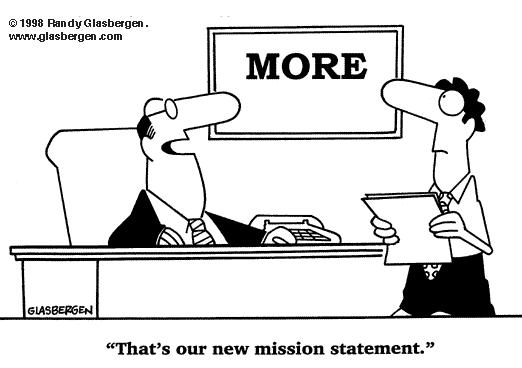
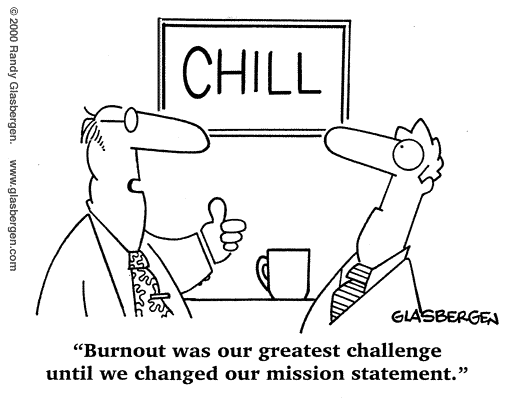
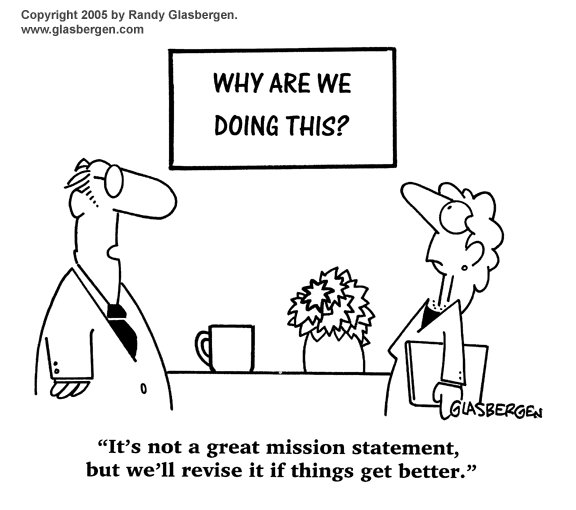
A while back the business world latched onto the idea of mission, and the results have not always been pretty. Mission statements of businesses are prone to either state the obvious, or state nothing at all.
  • “Aspire to excellence.”
  • “Client-focused providers.”
  • “Aiming to exceed expectations.”
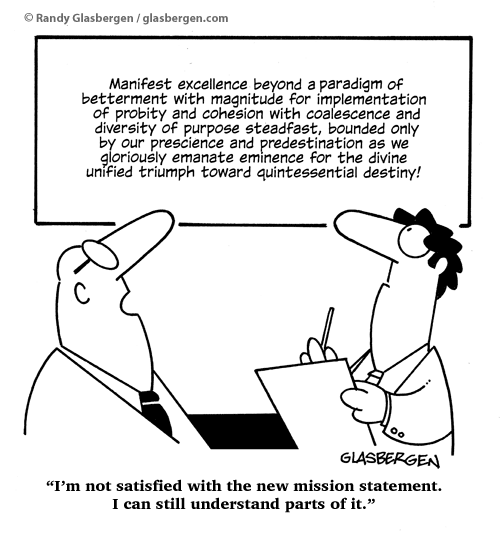
These are too banal to provide any help. Alternatively, mission statements fall prey to incomprehensibility. One cartoon shows two business people looking at a draft proposal for their mission statement – and some of the language evokes religious themes, but its so convoluted. The statement says:
“Manifest excellence beyond a paradigm of betterment with magnitude of probity and cohesion with coalescence and diversity of purpose steadfast, bounded only by our prescience and predestination as we gloriously emanate eminence for the divine unified triumph toward quintessential destiny.”
The one person is saying to the other:
“I’m not satisfied with the new mission statement. I can still understand parts of it.”
And then there are the sorts that are loaded with generically meaningless buzzwords. Dilbert creator Scott Adams parodies these with the "Dilbert Mission Statement Generator" which churns out such samples as:
"We have committed to synergistically fashion high-quality products so that we may collaboratively provide access to inexpensive leadership skills in order to solve business problems"
And:
"It is our job to continually foster world-class infrastructures as well as to quickly create principle-centered sources to meet our customer's needs"
And:
"Our challenge is to assertively network economically sound methods of empowerment so that we may continually negotiate performance based infrastructures"
Those are parodies. This one is real:
"The New Ventures Mission is to scout profitable growth opportunities in relationships, both internally and externally, in emerging, mission inclusive markets, and explore new paradigms and then filter and communicate and evangelize the findings."
Businesses are not congregations, and congregations are not businesses. We aren’t even a nonprofit business. Yet we have in common that we are complex organizations that have a lot of different things going on, and it's hard to sum up all those things in any way that provides meaningful guidance. So what often results is either banal or incomprehensible.

Community Unitarian Church is in the midst of a process for articulating our mission. Since we are not a business, we are a faith institution, a spiritual community, perhaps we can draw on spiritual wisdom to help us avoid the mission pitfalls into which many businesses fall.

For instance, our theme of the month for September is vision. "Vision" sounds like it’s about having a plan and goals: a “vision of the future” -- and sometimes it is. That sense of vision is not what I'd think of as a particularly spiritual resource. In a spiritual context, vision is about seeing who you are, what is your place, what is yours to do. The Biblical book of Proverbs (29:18) famously says,
“Where there is no vision, the people perish.”
The very next words, though, give it a spin you might not have expected:
“but he that keepeth the law, happy is he.” (KJV)
Other translations render it as:
“Where there is no prophecy the people cast off restraint, but happy are those that keep the law.” (NRSV)
Or:
"When people do not accept divine guidance, they run wild. But whoever obeys the law is joyful." (NLT)
Or:
"Where there is no revelation, people cast off restraint; but blessed is the one who heeds wisdom’s instruction." (NIV)
Proverbs is saying that vision -- a.k.a. prophecy, divine guidance, revelation -- is about perceiving that which shows us the way toward a fulfilling life. It’s seeing the context within which our lives make sense – seeing what we’re here for – and flowing with it.

It’s not that the picture of the future toward which you are working is entirely irrelevant . . . yet, from a spiritual standpoint, actually, yes, the picture of the future toward which you are working is entirely irrelevant.

Take a simple, quotidian task like washing the dishes. Thich Nhat Hanh says,
“We do not wash the dishes in order to get them clean. We wash the dishes in order to wash the dishes.”
This vision here is not a picture in my head of a tidy kitchen with all the dishes sparkling and neatly stacked in the cabinets. Rather, I would be bringing vision to my dishwashing insofar a I perceived that at that moment washing dishes was the best possible thing for me to be doing, and, indeed, the total fulfillment of the whole universe’s 14 billion years. That sudsy warm water. That slippery plate. My own wet hands. That’s what everything was for. That’s the meaning of it all, right there.

That’s vision. That kind of vision is indeed spiritual wisdom to draw on. If we could bring that kind of vision to everything we do, to every moment, then we'd be harmonizing ourselves to what the world presents to us. We'd be doing what Proverbs calls “keeping the law.” We'd be awake.

* * *
This part 1 of 5 of "Mission: Possible"
Next: Part 2: "Atone = At One"